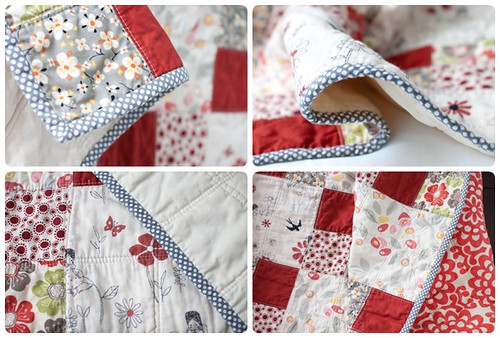
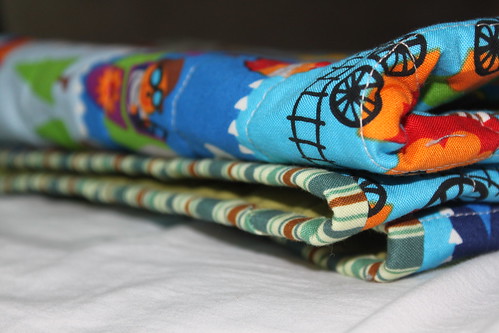
Showing posts with label JAQS Tutorial and Tips. Show all posts

Monday, March 10, 2014

A Couple of Completed Items & Apron Tutorial Revisited

Just noticed that it's been a while since I actually finished a project to post.  Good thing I have TWO to share today ;).

My first little minky blanket for Aya.  She's 16 months now and it's the weather is getting warmer, so it's time for a different lighter and slightly larger blanket.


The top is a cotton print from Riley Blake (found here).  I didn't want this blanket to be super girly so I went with a more gender neutral print and color.  For the backing I used a 'dimple minky'.  I didn't add any layers in the middle since I don't want her to be too warm in the upcoming months.

Next up, I decided to make a quick little half apron - the second one (first one posted here)...figure it's about time I had a backup.


A closeup of the print - LOVE IT!  I finally have an excuse to use the Ballerina canvas I had in my stash :).


In case you missed it-here's a repeat of the half apron tutorial I posted a little while back:

Here's how I did it:

Easy Half Apron Tutorial
  1. Cut your fabrics:
    • Top fabric: ~21" x 17"
    • Lining fabric: ~19" x 13"
    • Ties: 2 pieces 21" x 2.5"
    IMG_3789
  2. Make the 2 ties: Fold and sew raw edges 1/4" and fold together to form two strips for the ties
  3. IMG_3791
  4.  Put together the apron top:
    • Fold 1/4" and sew down all raw edges of the lining and top fabric
    • With the top fabric right side down , place the liner right side up on top of the top fabric.  Make sure that the liner fabric is about 1 inch lower than the top fabric.  
    • Fold down the two short edges of the top fabric over the liner and sew down.  Make sure that the top fabric is sewn so that the edge of the liner fabric is completely covered
    • Fold down top edge of the top fabric about 1" over the liner fabric.  Insert a tie on each end of the folded top.  Sew down the top edge and the inserted ties.
    IMG_3792
  5. Voila!  All done :)
IMG_3794

Thursday, August 15, 2013

Making Twill Tape Tags

If you've ever ordered my napkin sets (shameless plug ;)) you know that I use twill tape as a tag on each set up napkins.  They are each individually printed, ironed, cut and attached by yours truly.  I know it's tedious at times but I believe in the concept of making things from scratch...plus the process is relaxing when I have the time :).


So once in while I make a big batch of it and today I want to share with you some photos of this process.


Step 1: Design your logo and the REVERSE (aka mirror image) of it ready to print

Step 2: Print it on transfer paper like this one from Amazon

Step 3: Cut out your logos 

Step 4: Iron on (aka transfer on) to your twill tape


Step5: Cut to into individual labels


I make a bunch of these at a time and save them in a zipper bag.  A little tedious...a little therapeutic...but from scratch and saves a little bit of $$ :).

Saturday, July 13, 2013

Burp Cloth and Tutorial

Baby Aya is 8 months now and drooling off and on for a few months now.  After looking around for burp clothes and failing to find the ones I love using for my boys when they were little, I decided to sew some up myself :).

Here's the results - a nice stack of burp clothes ready to use:

burpCloth-9 

Since this picture I had made about 4 times as many, because babies drool a lot! On an average day I use 2-3 of these. Make extra - it'll save you time in the laundry room! 

burpCloth-6 

Here's a quick little picture tutorial of how to make these yourself:

Monday, June 13, 2011

Mini Bean Bags

I love working on little projects for the kids. With all the outdoor activities going on, I thought it would be nice to introduce them to a game of hopscotch. As a quilter and fabric enthusiast ;) I can't resist making my own little bean bags for their new outdoor game:

IMG_9006

Simple instructions:

-cut 2 pieces of fabric: 4.5" x 4.5"
-place fabrics right side together and sew together 3 of the 4 edges - 1/4" seam allowances
-flip right side out and fill about half way with beans (I used black eyed, but anything will do)
-fold down 1/4" inward along the un-sewn edge and sew shut -about 1/8" away from edge
-press along the other 3 sewn edges and sew about 1/8" away from edge for those as well

When complete it should look like a little pillow with matching edges :). Told you it was simple. I made a dozen for my boys in no time.

IMG_9002

Since I made them a few days ago, my boys have used them as attended - hopscotch. And some unattended purposes as well: throwing bags, stacked up as 'building' blocks, we have invented a few outdoor throwing games with it and now they are sitting in their play area as mini pillows for their action figures.

Try some :). They are super easy and fun to make. I'll be making a few extras as blanket weights. Take them along for a picnic so your blanket doesn't fly away :).

IMG_8999

I'll be sharing at these lovely linky parties.

-Q

Sunday, May 15, 2011

Red Poppies Flower Tutorial and Napkins

One of my all time favorite flowers are Red Poppies. It was up to me there will be fresh cut poppies around the house at all time - unfortunately they don't make good cut flowers. So here's my compromise:

IMG_7474

Fabric Red Poppies :). I had a bit of red fabric and some time on Friday to create something new for the home so I figure I'll make something I really enjoy but don't get to see that often.

These are sitting pretty in the little wooden crate. Originally designed to be part of a napkin topper for decoration:

IMG_7481


Here's a quick tutorial of how to make these poppies (makes 6):

Materials:
  • 6 strips of red fabric cut 4.5" x 14"
  • 6 black fabrics scraps (~4" x 4" each) 
  • 6 black fabric strips (1/3" x 6")
  • 6 strips of green fabric cut 1.5" x 14"
  • 6 bamboo sticks/skewers about 6" each
  • hot glue gun
  • scissor
Technique:
  1. Prep the poppy stem: Wrap each stick with one of the green fabrics - leave about 1/2" exposed where the flower would be attached later on
  2. IMG_7460
  3. Make the poppy center.  
    • Place one of the black fabric scraps on a flat surface and place some stuffing in the middle (I used some cut up fabric scraps).  
    • IMG_7457
    • Scrunch up the fabric around the stuffing to make a ball and tie the 'ball' with a strip of the black fabric.  Cut off the excess fabric.
    • IMG_7458
  4. Attach the poppy center to the exposed end of the poppy stem with some hot glue
  5. IMG_7461
  6. Prep the poppy petals.   Cut wavy lines on one of the long sides of each of the red fabric strips.  The cutting doesn't have to be precise to give it a more unique look for each poppy.
  7. IMG_7456
  8. Attach the poppy petal to the stem.  
    • Start with one of the the red fabric strip.  Hot glue a corner against the exposed poppy pen.  Make sure that the wavy end is facing upwards.
    • IMG_7464
    • Hot glue a small line against the long uncut end of the fabric strip - pinch and hot glue (if needed) against the poppy stem.  Continue this until the whole red fabric strip is against the step.  Make sure that the exposed stem area is completely covered by the poppy petal and the petal goes all around the stem.  Use a  little bit of hot glue to blue the start of the petal to the end so it forms a neatly enclosed poppy
    • IMG_7466
And voila!  A beautiful poppy.  Make a few or make a bunch.  These are great alone or to use for decor.
IMG_7467

Bunch them up for a nice bouquet:
IMG_7489

Thanks for visiting and I'll be sharing this tutorial at these lovely LINKY PARTIES.

IMG_7479

-Q

Tuesday, March 29, 2011

Binding Tutorial: Part 2 of 2

In the first part of the tutorial I went over 2 different type of binding cuts and how to assemble a folded binding. Now I will go over how to attach the binding, including hand binding.


I take a 2 stage approach to attaching the binding to a quilt - or any project with binding.

Stage 1: Machine Sew the Binding to the Quilt Top

A. Face the quilt with the quilt top facing up and measure about 2/3 of the way down from one edge of the quilt. Line up the raw edge of the quilt from that point with the raw edge of the binding - make sure you leave about 10" of the binding unused. Start sewing using about 1/4" from the raw edge - make sure you leave about 10" of the binding unused.
IMG_5097

(Steps B-E outline to creating miter corners.)
B. At each corner you want to stop about 1/4" from the end. Stitch back and forth a few stitches.
IMG_5098

C. Take the quilt and binding off the sewing machine and fold the binding up at a 45 degree angle.
IMG_5099

D. Fold the binding down on itself so that it lies along the unsewn edge.
IMG_5100

E. Start about 1/4" from the top of the unsewn edge, stitch back and forth a couple of times and then continue stitching the rest of the edge - again with 1/4" allowance.
IMG_5101

F. Once you get to the beginning of the binding, stop about 10" from where you started. Mark where the 2 bindings should join up once the binding is complete.
IMG_5102

G. Open up the binding and face at a 90 degree angle with right sides together. Pin to stay in place and mark where the stitch line should be.
IMG_5103

H. Sew on the stitch line and trim 1/4" from the sew line. Press open the seam, refold the binding and continue attaching the rest of the binding.
IMG_5105

Now that the binding is attached to the quilt top it is now time to decide now you want to attach it the quilt bottom. There are 2 basic approaches to this - either machine bind or hand bind. For (almost :P) all my quilts I have been using hand binding. I find that it makes for a more traditional looking quilt finish and gives the quilt that nice handmade feel...and if done correctly you do not see any threads.

Though you must be warned, hand binding takes WAY longer than machine binding. Today I'm just going to go over the hand binding technique. I'll try to create machine binding soon - probably the next quilt I decide to machine bind :).

IMG_6544

So onto...
Stage 2: Hand Sew Binding to the Quilt Bottom


The key to creating a nice even binding to a quilt is not to pull or tug on binding and to keep each stitch even...also keep it as 'Invisible' as possible :).

A. For hand stitching, use a hand quilting thread to prevent from breaking and knotting.  Choose a color that matches the binding and quilt bottom.  If you are using the technique that only sew on the binding you could choose a thread that matches the binding exactly.  If you choose the method that jumps from the binding to the quilt bottom, try to find a thread that matches both the binding and quilt bottom or an invisible thread. 

I usually use Gutermann 100% cotton for hand quilting:
IMG_5132

B. To start, tie a knot and stitch a few stitches to tie down the thread along the inside of the sew line from the binding top. Start this a few inches from a corner of the quilt.

IMG_5116

C. Fold the binding to cover the sew line, bring the needle out and into the edge of the binding - make sure you catch a few threads on the binding so the sewing thread will be nicely secured. Continue bringing needle through the binding and into the quilt bottom, catch a bit of the batting as well, but make sure you do not get any of the quilt top. Right now you needle should be about 1/8" from where you originally started the stitch, once you get to this distance, push the needle through through the quilt bottom, right along the sew line.  Pull the needle and thread back the position to start the next stitch.  Alternatively if you don't want the thread to be seen between the quilt bottom and binding at all you could push the needle through on the binding instead quilt bottom - in this case use a thread that is the same color as the binding.

IMG_5119


Step D - F goes over the miter corners for the quilt backing:

D. Continue doing step C until you come to a corner.  Stitch all the way to the edge of the binding.

IMG_5120

E. With the binding on the same edge as the sewn binding press down with one hand, and fold down the binding from the next edge over the sewn edge. Stitch into this folded miter corner to secure in place. Stitch a couple of times before continuing sewing on this new binding side.

IMG_5126

F. Continue sewing each edge and corner in this manner until you finish :). Your corners should look something like this:
IMG_5128

Hope this tutorial will help some of you who are not familiar with binding.  I'll keep this tutorial updated as I get feedback and have time to add more details.  Happy quilting :).

Go Back to JAQS Studio Tutorial & Tips

-Q

Tuesday, March 22, 2011

Binding Tutorial: Part 1 of 2

Binding is the perfect end to any quilt.  Besides from creating a sturdy edge to protect a quilt, binding can add playful, beautiful, used to complement a quilt top or even used to create contrast for an element of surprise.


Did I tell you that the binding part of a quilt is my favorite?? :)

In this HOW-TO guide I'll go share my techniques for binding a quilt.  

 First off let's go over the 2 basic types of binding I usually use to make binding:

(A) Straight-of-Grain binding: Cut from selvage to selvage. 

Some characteristics for straight-of-grain binding that I noticed:
  • Easy to cut since fabrics lies in a straight line when cutting.
  • Super simple to figure out how much fabric you need exactly.
  • I don't feel like I'm 'wasting' any fabric since I don't need to cut in an angle like on the bias binding.
  • Great for certain fabric patterns.  Especially stripes - LOVE striped binding!
  • Use it for only straight edged quilts.  Since it is cut straight on the grain, the binding doesn't bend well to contour curved/round edged quilts. 
  • For long term wear and tear, straight-of grain binding may need to be the secondary choice.  Since the same thread runs the whole length of the binding once its folded, it creates a vulnerable spot where the whole binding would be in jeopardy if that thread breaks.
I use it for all my straight edge quilts and projects.  Even though the last bullet point from above is a concern for some quilters, I haven't found it to be any problem at all.  I have had quilts for many years that have gone through A LOT of use and washings and the straight-of-grain binding has held up quite nicely. Once in a while I do use bias binding on straight-edged quilts but only for design/pattern purposes.


(B) Bias Binding: Cut  at 45% angle to the selvage edges of the fabric.

Some characteristics for Bias binding that I noticed:
  • Creates a very stretchy binding that is great for rounded edges.  This is the only way to attacked quilts that are not straight-edged all around.
  • More traditional approach to binding that is recognized to create the sturdiest binding.  
  • To create long strips to make continuous binding without a lot of seams, you do waste some fabric - the triangle leftover after the first and last cut.  
Once cut, the bias and straight-on-grain binding strips are assembled and applied the same way to the quilt top.  So the steps below applies to BOTH binding cutting techniques.  But do keep in mind that if you are binding for a curved edged quilt, do use the bias binding method so your binding can be stretched along with the curve.  For straight-edge quilts, you decide which cutting method you want :).


OK - on to the actual making of the binding :).  Here's step by step instructions on how to create and attach binding to a quilt:


How much binding do you need?

For now this tutorial will only be straight on grain binding.  I'll update on a later date on the details of bias binding - probably when I create a new quilt with curved edges so I would need the bias binding :).  Other sites details bias binding if you need the info right now like here, here and here.

For straight binding use the following calculations for total length and number of strips needed:


Assembling the strips

1. Lay 2 ends perpendicular of each other, with right sides facing each other. With a marking pen, mark where you need to sew - see picture below:
IMG_5107

2. Sew along the marked line and trim along seam with 1/4" allowance:
IMG_5111

3. Press seam open and trim off extra fabric:
IMG_5112

4. Once all the strips are sewn together and pressed, fold in half with right side facing outward and press. Now your binding is ready to use:
IMG_5115


Continue to Binding Tutorial: Part 2 of 2 for instructions on how to attach the binding and hand binding tips...coming soon!


As usual I share all my completed projects with these lovely linking parties :).

-Q

LinkWithin

Related Posts Plugin for WordPress, Blogger...